
In the global automotive landscape, Original Equipment Manufacturers (OEMs) rely heavily on Tier-1 suppliers to deliver critical components that shape the safety, performance, and reliability of their vehicles. As the industry rapidly advances with electrification, automation, and sustainability goals, OEM expectations have become more rigorous than ever. For a supplier to stand out on the global stage, it must meet demanding standards, exceed quality benchmarks, and embrace a culture of continuous improvement.
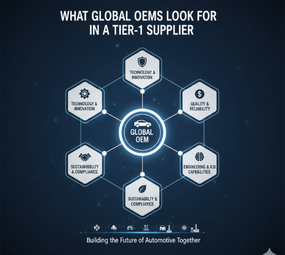
The Rising Expectations from Global OEMs
The modern automotive supply chain leaves no room for compromise. Every component—whether a sensor, floor system, or powertrain part—must be engineered with precision and manufactured to the highest standards. Global OEMs assess a supplier not just on product quality but on reliability, innovation, sustainability, and operational discipline.
At the center of these expectations is IATF 16949, the world’s most trusted quality management standard for automotive manufacturing.
1. Strict Adherence to Global Quality Standards
One of the first things OEMs demand is compliance with internationally recognized quality certifications.
IATF 16949: The Gold Standard
This standard ensures suppliers follow robust processes for defect prevention, production consistency, traceability, and risk mitigation.
For OEMs, IATF 16949 certification signals the following:
- A structured, reliable manufacturing environment
- Commitment to continuous improvement
- Ability to reduce variation and waste
- Strong focus on customer satisfaction
Suppliers lacking this certification rarely enter the global supply chain.
2. Consistent Product Performance and Zero-Defect Mindset
Global OEMs operate with high expectations around product integrity. They look for suppliers who can repeatedly deliver:
- Exact specifications
- Tight tolerances
- Stable performance under all environmental conditions
A “zero-defect” approach is not optional—it’s essential. Suppliers must adopt advanced inspection systems, statistical process control (SPC), and automated quality checks to minimize human error and ensure perfect repeatability.
3. Strong Innovation and R&D Capabilities
OEMs value suppliers who think beyond today’s requirements. With the industry embracing EVs, ADAS, and lightweight materials, Tier-1 suppliers must:
- Invest in R&D
- Develop new materials and technologies
- Offer design-engineering support
- Provide simulation/testing capabilities
Innovation creates long-term partnerships and positions the supplier as a strategic collaborator rather than just a manufacturer.
4. Supply Chain Reliability and On-Time Delivery
A single delayed component can halt an entire production line. OEMs expect:
- Predictable lead times
- Robust logistics planning
- Advanced inventory management
- Contingency plans for disruptions
Suppliers must demonstrate the ability to deliver consistently—even during global crises, raw material shortages, or transportation challenges.
5. Financial Stability and Long-Term Commitment
OEM partnerships often span 5–10 years. Along with operational capabilities, financial strength matters. OEMs assess:
- Company stability
- Investment capacity
- Growth potential
- Risk management practices
Financially strong suppliers inspire confidence and enable sustained collaboration.
6. Sustainability, Compliance & Environmental Responsibility
Automotive giants are moving toward carbon neutrality. Suppliers are now evaluated on:
- Energy-efficient manufacturing
- Waste reduction
- Recyclable or eco-friendly materials
- ESG (Environmental, Social & Governance) compliance
A sustainable supplier is not just preferred—it is often a requirement.
7. Transparent Communication and Technical Support
OEMs expect suppliers to act as partners. This includes:
- Clear, proactive communication
- Rapid response to technical issues
- Joint problem-solving
- Dedicated engineering and quality support teams
Transparency builds trust and ensures smooth project execution.
Conclusion: The Tier-1 Supplier of the Future
To meet the needs of global OEMs, a Tier-1 supplier must be more than a manufacturer—it must be a technology partner, a quality leader, and a sustainability champion. With stringent certifications like IATF 16949, a zero-defect culture, innovation-driven processes, and a strong commitment to reliability, suppliers can secure long-term relationships with the world’s leading automotive brands.
The automotive industry is evolving faster than ever, and the suppliers who match this pace with excellence and discipline will define the future of mobility.